
Are you trying to build muscle but not sure if you’re making real progress? Or maybe you’ve lost weight, but you’re worried you lost muscle instead of fat? Fat-Free Mass Index (FFMI) is a simple number that tells you how much muscle you have relative to your height. Unlike BMI, which can’t tell the difference between muscle and fat, FFMI focuses only on your lean body mass. In this guide, you’ll learn exactly what FFMI is, how to calculate it, what your score means, and how to use it to reach your fitness goals.
Fat-Free Mass Index (FFMI): Complete Guide to Measuring Lean Muscle Mass
Fat-Free Mass Index (FFMI Calculator)
- Fat Free Mass
- 154.00 lbs
- Body Fat
- 26.00 lbs
- FFMI
- 22.13
- Normalized FFMI
- 22.34
3 feet8 feet
90 cm245 cm
65 lbs350 lbs
30 kg160 kg
0 %70 %
161718192021222324252627282930
What is FFMI?
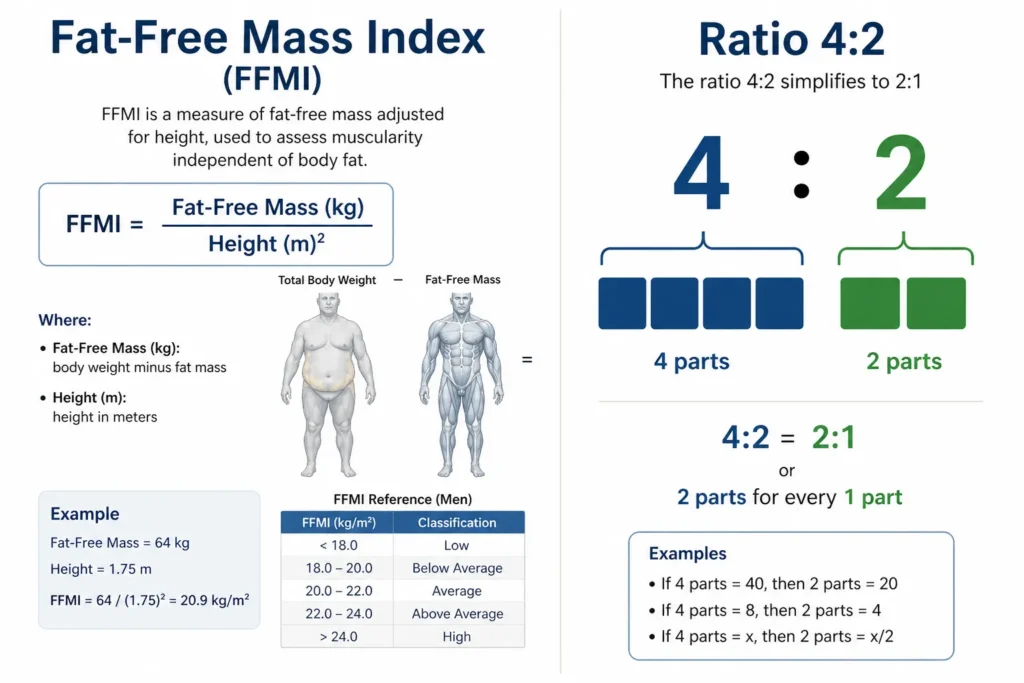
FFMI (Fat-Free Mass Index) is a metric used to evaluate how much lean mass (muscle, bone, and water) your body carries relative to your height. Unlike BMI, which only considers total body weight, FFMI provides a clearer picture of body composition.
Because it separates muscle from fat, FFMI is especially useful for:
- Athletes and bodybuilders tracking muscle development
- Comparing physiques across different heights
- Estimating natural muscular potential
- Monitoring progress during bulking or cutting phases
In short, FFMI answers a more meaningful question than BMI:
“How muscular am I for my height?”
FFMI Formula
To calculate FFMI, follow these steps:
- Total Body Fat (lbs or kg)
= Weight × (Body Fat % ÷ 100) - Lean Body Mass
= Weight × (1 − (Body Fat % ÷ 100)) - FFMI
= (Lean Body Mass ÷ 2.2) ÷ (Height in meters)² - Adjusted FFMI (Normalized for height)
= FFMI + [6.3 × (1.8 − Height in meters)]
Height in meters = (Feet × 12 + Inches) × 0.0254
FFMI Interpretation
Your calculated (normalized) FFMI can be compared against standard ranges. Keep in mind that interpretations differ between men and women.
FFMI Ranges for Men
| FFMI | Body Fat | Description |
|---|---|---|
| 17–18 | 10–18% | Lean / Skinny |
| 18–20 | 20–27% | Average |
| 19–21 | 25–40% | Overfat |
| 20–21 | 10–18% | Athletic |
| 22–23 | 6–12% | Advanced |
| 24–25 | 8–20% | Bodybuilder / Strength Athlete |
FFMI Ranges for Women
| FFMI | Body Fat | Description |
|---|---|---|
| 14–15 | 20–25% | Lean |
| 14–17 | 22–35% | Average |
| 15–18 | 30–45% | Overfat |
| 16–17 | 18–25% | Athletic |
| 18–20 | 15–22% | Advanced |
| 19–21 | 15–30% | Bodybuilder / Strength Athlete |
How to Use the Calculator
- Select your preferred measurement system (Imperial or Metric)
- Enter your height
- Enter your weight
- Input your body fat percentage
- Click “Calculate” to view your FFMI results
Frequently Asked Questions (FAQ)
A good FFMI for men is 20–23. Average untrained men score 18–20, while serious lifters with several years of training typically reach 22–23. Scores above 25 are rare without performance-enhancing drugs.
A good FFMI for women is 16–18. Average women score 14–16, while female athletes and dedicated lifters achieve 17–19. Natural female bodybuilders may reach 19–20.
Yes, FFMI is better than BMI for fitness assessment because it distinguishes between muscle and fat. BMI only measures total body weight versus height, so it incorrectly classifies muscular people as overweight. FFMI gives a clearer picture of body composition.
Yes. FFMI only measures muscle mass, not cardiovascular health, metabolic health, or fat distribution. You can have good muscle mass but poor heart health, high blood pressure, or dangerous visceral fat levels.
Increase FFMI by:
- Strength training 3-5x per week
- Eating 1.6-2.2 g protein per kg body weight
- Maintaining a small calorie surplus (200-500 calories)
- Getting 7-9 hours of sleep
- Being consistent for months/years
Yes, FFMI accuracy depends on body fat measurement accuracy. If your body fat percentage is off by 5%, your FFMI will be wrong too. Use reliable methods like DEXA scans or consistent BIA measurements.
Most natural men max out around FFMI 23-25. Research suggests 25 is the upper limit for most natural bodybuilders. Women naturally max out around FFMI 19-21. Scores significantly above these levels usually indicate steroid use or exceptional genetics.
Yes, FFMI typically declines with age due to sarcopenia (muscle loss). People lose 3–8% of muscle mass per decade after age 30. However, resistance training and proper nutrition can slow or prevent this decline.
Measure FFMI every 4-6 weeks if you’re actively trying to build muscle or lose fat. More frequent measurements aren’t helpful because muscle changes slowly. Less frequent measurements (quarterly) work for maintenance.
Yes, some beginners naturally have higher FFMI due to genetics, previous athletic background, or physical labor jobs. However, untrained individuals rarely exceed FFMI of 20 (men) or 16 (women) without prior strength training.